Showing posts with label khaira ismail. Show all posts

Monday, September 24, 2007

Corporate giants face up to climate change

Big business is facing up to climate change with more than half of the world's 500 largest companies introducing schemes to reduce greenhouse gas emissions, a report says today.
The Carbon Disclosure Project's (CDP) fifth annual global report finds that 76% of the FTSE 500 companies who responded to its survey have put emissions reduction schemes in place - compared to 48% last year.
Some 80% of public-owned companies who responded to the survey see climate change as presenting risks and opportunities for their business. Some 95% of those who see climate change as a commercial risk have implemented emissions reduction programmes with a specific target and timeline.
But the 383 top companies who responded to the survey report greenhouse gas emissions totalling almost seven billion tonnes, which represents 14% of all global emissions by humans.
The CDP report concludes that corporate giants had made "significant progress in understanding and disclosing their positions relative to the risks and opportunities associated with climate change." In particular, the report highlights a narrowing gap between climate awareness and action among the FT500.
But it finds that a fifth of companies disregarded shareholders' requests for information about their response to climate change, and that climate change is not yet the responsibility of top management in many companies.A report on major US firms revealed that many are lagging behind the FTSE500 with only 29% of survey respondents implementing emissions reductions schemes.
The New-York based CDP is a collaboration of more than 315 global institutional investors, with assets totalling more than $41 trillion (£20 trillion). It is also today launching a Climate Disclosure Leadership Index, to highlight 68 companies in the FTSE500 that are leading the way on disclosing and reducing their emissions. They include Royal Bank of Scotland, Unilever, Hewlett Packard and Coca-Cola.
A separate partnership with Wal-Mart Stores Inc. will also be announced. It will engage Wal-Mart's supply chain to report greenhouse gas emissions, emissions reduction targets and climate change strategies.
Paul Dickinson, the CDP's chief executive officer, says the partnership between CDP and Wal-Mart is a "very significant milestone in corporate action to mitigate climate change".
He adds: "Increasingly, investors view good carbon management as a sign of good corporate management. As CDP data plays an increasingly important role in informing investors on a company's approach to climate change, the pressure is increasing on companies to respond. And by moving CDP data collection into company supply chain management, CDP's reach will grow enormously."

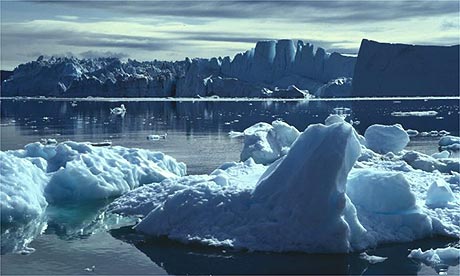
Grim outlook for poor countries in climate report

The Arctic is again highlighted as being among areas most at risk. Photograph: Corbis

The effects of climate change will be felt sooner than scientists realised and the world must learn to live with the effects, experts said today.
Professor Martin Parry, a climate scientist with the Met Office, said destructive changes in temperature, rainfall and agriculture were now forecast to occur several decades earlier than thought.
He said vulnerable people such as the old and poor would be the worst affected, and that world leaders had not yet accepted their countries would have to adapt to the likely consequences.
The professor was speaking in London at a meeting to launch the full report on the impacts of global warming by the UN's Intergovernmental Panel on Climate Change (IPCC).
The report – which had its executive summary released earlier this year – says hundreds of millions of people in developing nations will face natural disasters, water shortages and hunger due to the effects of climate change.
Today Professor Parry, co-chair of the IPCC working group that wrote the report, said: "We are all used to talking about these impacts coming in the lifetimes of our children and grandchildren. Now we know that it's us."
He said the international response to the problem had failed to grasp that serious consequences such as reduced crop yields and coastal flooding were now inevitable. "Mitigation has got all the attention but we cannot mitigate out of this problem. We now have a choice between a future with a damaged world or a severely damaged world."

Countries such as Britain need to focus on helping nations in the developing world cope with the predicted impacts, by helping them to introduce irrigation and water management technology, drought resistant crops and new building techniques.
Dr Rajendra Pachauri, chair of the IPCC, said: "Wheat production in India is already in decline, for no other reason than climate change."
The report says that "extreme weather events" are likely to become more intense and more frequent, while higher global temperatures could affect crops and water supplies and spread disease.
The effect on ecosystems could be equally severe, with up to 30% of plant and animal species at risk of extinction if the average rise in global temperatures exceeds 1.5-2.5C.
The 1,000-page document is part of the IPCC's fourth overall assessment of climate change, to be published in full later this year. It was put together by the so-called Working Group II, which examines global warming's impact on the environment and people.
The experts involved warn that the consequences of rising temperatures are already being felt on every continent, and sooner than expected. It is "probably too late" to avoid some impacts in developing countries because about 1C of warming is already in the climate system, they warn. If it is not kept below 2C – which "currently looks very unlikely to be achieved" – up to 3.2 billion people will face water shortages and up to 600 million will face hunger, they have predicted.
The trade and development minister, Gareth Thomas, told the launch of the report at the Royal Geographical Society: "Failing to tackle it [climate change] will lead to floods, droughts and natural disasters which can destroy poor people's lives as well as their livelihoods."
Professor Parry said today that he was pessimistic about the chances of keeping the increase in global average temperatures below 2C. "And it's evident from the work of the IPCC that even with a maximum of 2C we're not going to avoid some major impacts at the regional level."
In February the report of the IPCC's first working group, which looks at the scientific background of climate change, concluded that global warming was "very likely" – a probability of 90% or greater – to have been caused by human activity.
A report in May by the IPCC's Working Group III, which examines how climate change can be addressed, argued that devastating global warming can be avoided without excessive economic cost but only if the world begins acting immediately.
Today's report concludes that while the impact of a warmer globe will have mixed effects – for example, it notes that crop yields could increase in northern Europe – the overall impact will be deeply negative, particularly in Africa, in the so-called "mega-deltas" of south and east Asia, and on small islands and in polar regions.
By 2020, the report warns, up to 250 million Africans may be left short of water, while access to sufficient food is "projected to be severely compromised by climate variability and change".
"New studies confirm that Africa is one of the most vulnerable continents to climate variability and change because of multiple stresses and low adaptive capacity," says the document.

Climate campaign to stop ill wind

The Vegetarian Society is to raise awareness of "emissions" from cattle as a leading cause of global warming with an ad campaign using the strapline "Silent but deadly".
Sir Paul McCartney and daughter Stella are patrons of the Vegetarian Society, which argues that "damaging gaseous emissions" from farmed animals exceed those from the world's entire transport system.
The campaign, which features a close-up of the rear of a cow, will include a range of "Silent but deadly" postcards and press ads that will run in environmental and ethical magazines over the coming months.
Ads will run in publications including Ethical Consumer, Ecologist, the Green Planet and Organic Life, as well as the Friends of the Earth's members' magazine Earth Matters.
"'Silent but deadly' is about getting the reader's attention, making them think and hopefully wanting to find out more about the connection between diet and climate change," said the Vegetarian Society head of communications, Liz O'Neill.
The ad claims that farmed animals produce 18% of the world's greenhouse gas emissions, while the global transport industry accounts for 13.5%.
The advertisement finishes with the line "It's not just a lot of hot air."

Saturday, September 15, 2007

Arctic ice melt opens Northwest Passage

PARIS - Arctic ice has shrunk to the lowest level on record, new satellite images show, raising the possibility that the Northwest Passage that eluded famous explorers will become an open shipping lane.
The European Space Agency said nearly 200 satellite photos this month taken together showed an ice-free passage along northern Canada, Alaska and Greenland, and ice retreating to its lowest level since such images were first taken in 1978.
The waters are exposing unexplored resources, and vessels could trim thousands of miles from Europe to Asia by bypassing the Panama Canal. The seasonal ebb and flow of ice levels has already opened up a slim summer window for ships.
Leif Toudal Pedersen, of the Danish National Space Center, said that Arctic ice has shrunk to some 1 million square miles. The previous low was 1.5 million square miles, in 2005.
"The strong reduction in just one year certainly raises flags that the ice (in summer) may disappear much sooner than expected," Pedersen said in an ESA statement posted on its Web site Friday.
Pedersen said the extreme retreat this year suggested the passage could fully open sooner than expected — but ESA did not say when that might be. Efforts to contact ESA officials in Paris and Noordwik, the Netherlands, were unsuccessful Saturday.
A U.N. panel on climate change has predicted that polar regions could be virtually free of ice by the summer of 2070 because of rising temperatures and sea ice decline, ESA noted.
Russia, Norway, Denmark, Canada and the United States are among countries in a race to secure rights to the Arctic that heated up last month when Russia sent two small submarines to plant its national flag under the North Pole. A U.S. study has suggested as much as 25 percent of the world's undiscovered oil and gas could be hidden in the area.
Environmentalists fear increased maritime traffic and efforts to tap natural resources in the area could one day lead to oil spills and harm regional wildlife.
Until now, the passage has been expected to remain closed even during reduced ice cover by multiyear ice pack — sea ice that remains through one or more summers, ESA said.
Researcher Claes Ragner of Norway's Fridtjof Nansen Institute, which works on Arctic environmental and political issues, said for now, the new opening has only symbolic meaning for the future of sea transport.
"Routes between Scandinavia and Japan could be almost halved, and a stable and reliable route would mean a lot to certain regions," he said by phone. But even if the passage is opening up and polar ice continues to melt, it will take years for such routes to be regular, he said.
"It won't be ice-free all year around and it won't be a stable route all year," Ragner said. "The greatest wish for sea transportation is streamlined and stable routes."
"Shorter transport routes means less pollution if you can ship products from A to B on the shortest route," he said, "but the fact that the polar ice is melting away is not good for the world in that we're losing the Arctic and the animal life there."
The opening observed this week was not the most direct waterway, ESA said. That would be through northern Canada along the coast of Siberia, which remains partially blocked.

Friday, September 14, 2007

New Gore book to set out inconvenient solutions


Al Gore promotes his film about climate change. Photograph: Samantha Sin/AFP
The former US vice-president Al Gore is working on a new book about the environment as a sequel to An Inconvenient Truth, his Oscar-winning film about global warming.
The Path to Survival will be published next spring to coincide with Earth Day on April 22.
According to the publisher, Rodale Books, Gore will spell out a blueprint for the changes that individuals and governments need to make to avoid catastrophic climate change.
In a statement it said the book would explain how "bold choices now to protect our environment will also create new jobs, propel sustainable economic improvements, and inspire a new generation to tackle our most challenging issues with moral leadership".

It said the book would be, "part scientific manual, part exposé, part visionary call for a new planet-wide political movement".
Rodale said Path to Survival would "appeal to those who were motivated by the call to action of An Inconvenient Truth and who are now ready to fight for the solutions that were considered politically impossible only a short time ago".
As yet there are no plans to turn the book into a movie.
An Inconvenient Truth was released as a film in 2006 and won an Oscar for best documentary. Its screenings, notably in schools, have helped to reinforce the growing consensus about the dangers of climate change.
A book to accompany the film topped the New York Times bestseller list for non-fiction paperbacks.
Gore's most recent book, The Assault On Reason, was a relentless attack on the administration of the US president, George Bush, who narrowly defeated Gore in the 2000 election.
Meanwhile, Gore has again declined to completely rule out running for president next year.
But in an interview with 02138, a magazine for Harvard graduates, he said: "It doesn't feel right at this point." He also said he doubted he would ever completely rule out a return to politics in the future.
In the interview he backed a proposal by the Democratic presidential hopeful Chris Dodd for a carbon tax on polluters.
"I'm convinced that we should eliminate the payroll tax and replace it dollar for dollar with a (carbon) tax," he said.
Gore said he would probably endorse one of the Democratic party's presidential candidates next year, but not necessarily Hillary Clinton, the wife of his former boss.
Asked if he felt an obligation to support Mrs Clinton, he said: "Uh ... no. I have friendships with her and other candidates, and they're all on equal footing at this point as far as I'm concerned."

Human activity linked to heavier rainfall

Greenhouse gas emissions from human activity are causing global shifts in rainfall patterns and contributing to wetter weather over the UK, climate scientists say today.
Their study is the first to find a "human fingerprint" in the rainfall changes which have been detected in a belt of the northern hemisphere stretching from the Mediterranean to the UK to Norway.
The results, based on a global comparison of weather records going back to 1925, suggest that levels of rainfall across the UK have increased steadily by an average of 6.2 millimetres every decade. At least half of the extra rainfall and possibly up to 85% is caused by the impact of greenhouse gas emissions, the scientists conclude.
The research, carried out by the Hadley Centre of the UK Met Office in conjunction with several national climate research institutes, does not prove that any single episode of extreme wet weather can be directly linked to climate change, but it supports the idea of a long-term rise in rainfall linked to emissions.
The study, published today in the journal Nature, adds weight to the growing belief that the UK is experiencing a fundamental shift in weather pattern with bursts of extremely hot conditions and almost tropical downpours.
As waters of the Severn, Avon and Thames continue to rise, the Environment Agency described conditions in central England as the "worst floods in modern times". Tens of thousands of homes have lost power and water supplies, and river levels are not expected to reach their peak in the cities of Gloucester and Oxford until today.
Gordon Brown, who flew over the flood region yesterday, used his first monthly press conference since arriving at Number 10 to make the clear link between global warming and the flood devastation. He said: "Like every advanced industrialised country, we are coming to terms with the issues surrounding climate change.
"We are going to have to look at drainage, surface water, as well as river water, and what we are going to be able to do in the future in relation to that. We will have to invest in coastal defences, flood defences and, of course, drainage in infrastructure in the years to come and that's why we are setting aside more resources to do so."
Today's study compared records from weather stations around the world going back to 1925 with predictions from 10 computer models of global climate. Some models included the effects of human-induced climate change while others took into account only natural changes or more exotic factors such as volcanoes and the sun's activity. Only models factoring in human-induced climate change could adequately explain the observed changes in rainfall, the scientists found.
"The paper is saying there is a significant human influence on global rainfall patterns," said Dr Peter Stott at the Met Office's Hadley Centre, who was part of a team led by researchers at the Climate Research Division of the Canadian government's environment department.
"The study looks at the trends in annual precipitation, but we don't address the trickier issue of what is happening with the extreme events. Especially regionally, that is harder to discern because there is much more variability and the events are rarer as well, so it is a more difficult problem."
Apart from the increase in rain in northern high latitudes - the belt between 40 and 70 degrees north which includes the UK - the analysis found that climate change brought wetter conditions in the southern tropics and subtropics.
It also found a link between global warming and drier conditions in the northern tropics and subtropics. "This is a very important paper," said Myles Allen, head of the climate dynamics group at Oxford University. "We already knew that external drivers like volcanic eruptions affect large-scale precipitation, but for the first time this paper identifies the fingerprint of human influence. This means that the precipitation trends they identify may be harbingers of more to come."
In the UK, the long-term forecast is for wetter winters and drier summers. "The really difficult one to figure out is that even under drier summers you might get more extreme events," Dr Stott said.
Chris Huntingford a climate modeller at the Centre for Ecology and Hydrology in Wallingford, said: "It has now been confirmed that the burning of fossil fuels has altered rainfall patterns at the global scale. Next we need to understand how these observed large-scale adjustments translate to local changes in extreme rainfall events.
"These highly regionalised estimates of rainfall will be essential in aiding governments to prepare for what might, in some circumstances, represent dangerous climate change"

New analysis counters claims that solar activity is linked to global warming


An ultraviolet image of the Sun shows a solar flare leaping out from an active sunspot. Photograph: Nasa/EPA


It has been one of the central claims of those who challenge the idea that human activities are to blame for global warming. The planet's climate has long fluctuated, say the climate sceptics, and current warming is just part of that natural cycle - the result of variation in the sun's output and not carbon dioxide emissions.
But a new analysis of data on the sun's output in the last 25 years of the 20th century has firmly put the notion to rest. The data shows that even though the sun's activity has been decreasing since 1985, global temperatures have continued to rise at an accelerating rate.
The solar hypothesis was championed publicly in March by the controversial Channel 4 documentary The Great Global Warming Swindle.
The programme has been heavily criticised for distorting scientific data to fit the sceptic argument and Carl Wunsch, a professor of physical oceanography at MIT who featured in the programme, later said that he was "totally misled" by the film makers and that his comments were "completely misrepresented".
The new analysis is designed to counter the main alternative scientific argument put forward by the programme - that solar activity may be to blame for global warming.
"The temperature record is simply not consistent with any of the solar forcings that people are talking about," said lead author Mike Lockwood at the Rutherford Appleton Laboratory in Oxfordshire.
"They changed direction in 1985, the climate did not ... [the temperature] increase should be slowing down but in fact it is speeding up."
Global temperatures are going up by 0.2 degrees per decade and the top 10 warmest years on record have happened in the past 12 years.
One way that the sun affects the climate is through clouds. The sun's magnetic field shields the Earth from its high energy particles called cosmic rays. The rays help form clouds that reflect the sun's energy back into space and cool the planet.
So if the sun's magnetic field is high, there should be a fall-off in cosmic rays, fewer clouds and more warming. But Prof Lockwood's data, published today in the Proceedings of the Royal Society, shows the sun's magnetic field has declined since 1985, even as the world heats up.
James Hansen, a Nasa climate scientist who was once gagged by the Bush administration for speaking out on global warming, said the issue of whether the sun's activity is causing global warming had been dispensed with by most scientists long ago. "The reason [this paper] has value is that the proponents of the notion that the sun determines everything come up with various half-baked suggestions that the sun can somehow cause an indirect forcing that is not included in the measurements of radiation coming from the sun," he said. "These half-baked notions are usually supported by empirical correlations of climate with some solar index in the past. Thus, by showing that these correlations are not consistent with recent climate change, the half-baked notions can be dispensed with."
Prof Lockwood said the study was "another nail" in the coffin of the notion that solar activity is responsible for global warming.
Nir Shaviv, an astrophysicist at the Hebrew University of Jerusalem and a proponent of the solar hypothesis, has tried to rescue the idea by invoking a time lag between changes in the sun and its effect on the Earth's climate. But Prof Lockwood dismissed this as "disingenuous".
"Nobody has invoked that kind of lag before. It's only been invoked now as a way out," he said. Even if the lag were 50 years then he believes we would begin to see the rise in global temperatures slowing down.
Even though there is almost no argument among scientific circles about the role of human activities as the main driver of climate change, a recent poll suggested that the public still believes there is significant scientific uncertainty. Despite the efforts of government and campaigns such as Live Earth to educate the public, the Ipsos Mori poll of over 2,031 people, released this month, found 56% of people thought there was an active scientific debate into the causes of global warming.
A spokesman for the Royal Society, the UK's leading scientific academy, said: "This is an important contribution to the scientific debate on climate change. At present there is a small minority which is seeking to deliberately confuse the public on the causes of climate change. They are often misrepresenting the science, when the reality is that the evidence is getting stronger every day. We have reached a point where a failure to take action to reduce carbon dioxide and other greenhouse gas emissions would be irresponsible and dangerous."
Channel 4 and Martin Durkin, producer of The Great Global Warming Swindle, declined to comment.

Big rise in number of Atlantic storms blamed on global warming

Climate scientists have blamed global warming for a dramatic rise in the number of storms in the Atlantic over the past century. Their study showed the average number of storms that develop every year has doubled since 1905.
They suggest the trend is due to the rise in sea surface temperatures in the Atlantic, a phenomenon with a well-established link to climate change.
Tropical storms are powered by the energy in the oceans they pass over, with warmer sea surfaces leading to more intense storms. In the past century, the surface temperature of the Atlantic has risen by 0.7C.
The increase in storm frequency was most recently visible in 2005, with more than double the average number of storms, including Hurricane Katrina, the most costly natural disaster in US history. It claimed almost 2,000 lives.
In the new study, Greg Holland of the US National Centre for Atmospheric Research in Boulder, Colorado, calculated the average number and intensity of Atlantic storms over the past century and identified three distinct climate regimes.
The first, between 1905 and 1930, had an average of six major storms a year, four of which were hurricanes, meaning wind speed exceeded 74mph. During the second, from 1931 to 1994, the annual average rose to 10 storms, five of which were hurricanes.
From 1995 to 2005, there were an average of 15 storms a year, eight of which were hurricanes. According to the researchers, this last period has not yet stabilised, so the average could rise still further.
Last year, the hurricane season was less active than 2004 and 2005 because of El Niño, an upwelling of warm water off the coast of Ecuador. But even that activity was higher than a century ago with five hurricanes. The research comes as MPs warn that the government must strengthen climate change targets. They also call for the UK's share of emissions from international aviation and shipping to be included in goals in the draft climate change bill.
The environmental audit committee's report argues: "The government's policy towards the UK's 2050 target is clearly incoherent. The government remains committed to limiting global warming to a rise of 2C; but it also acknowledges that, according to recent scientific research, a cut in UK emissions of 60% by 2050 is now unlikely to be consistent with delivering this goal. This target should be strengthened."
Tim Yeo, the chairman, said the report exposed weaknesses in climate change policy. "Carbon-saving measures have not delivered as much as predicted, and forecasts of emissions have consistently drifted upwards. To make things worse, these forecasts have not been updated often enough."
He added: "The use of international carbon credits must be limited and transparently reported - and not be used as an excuse for inaction at home."
The report praises improvements in joining up the work of different departments, but notes that fiscal policy was excluded from last year's climate change programme review.
"In the future, there must be an integrated approach to climate change policymaking which considers the use of taxes and incentives," it says.
Hilary Benn, the environment secretary, said: "The 60% unilateral commitment is ambitious by any standard and consistent with our leading position internationally. However, we recognise that we will need to keep this goal under review in the light of emerging scientific evidence."

Biofuels switch a mistake, say researchers...

Increasing production of biofuels to combat climate change will release between two and nine times more carbon gases over the next 30 years than fossil fuels, according to the first comprehensive analysis of emissions from biofuels.
Biofuels - petrol and diesel extracted from plants - are presented as an environmentally friendly alternative to fossil fuels because the crops absorb carbon dioxide from the atmosphere as they grow.
The study warns that forests must not be cleared to make way for biofuel crops. Clearing forests produces an immediate release of carbon gases into the atmosphere, accompanied by a loss of habitats, wildlife and livelihoods, the researchers said.
Britain is committed to substituting 10% of its transport fuel with biofuels under Europewide plans to slash carbon emissions by 2020.
"Biofuel policy is rushing ahead without understanding the implications," said Renton Righelato of the World Land Trust, a conservation charity. "It is a mistake in climate change terms to use biofuels."
Dr Righelato's study, with Dominick Spracklen from the University of Leeds, is the first to calculate the impact of biofuel carbon emissions across the whole cycle of planting, extraction and conversion into fuel. They report in the journal Science that between two and nine times more carbon emissions are avoided by trapping carbon in trees and forest soil than by replacing fossil fuels with biofuels.
Around 40% of Europe's agricultural land would be needed to grow biofuel crops to meet the 10% fossil fuel substitution target. That demand on arable land cannot be met in the EU or the US, say the scientists, so is likely to shift the burden on land in developing countries.
The National Farmers Union said 20% of Britain's agricultural land could be used to grow biofuels by 2010. However, the researchers say reforesting the land would be a better way to reduce emissions.
Biofuels look good in climate change terms from a Western perspective, said Dr Spracklen, but globally they actually lead to higher carbon emissions. "Brazil, Paraguay, Indonesia among others have huge deforestation programmes to supply the world biofuel market", he said.
The researchers say the emphasis should be placed on increasing the efficiency of fossil fuel use and moving to carbon-free alternatives such as renewable energy

Ice-free Arctic could be here in 23 years!

The Arctic ice cap has collapsed at an unprecedented rate this summer and levels of sea ice in the region now stand at a record low, scientists said last night. Experts said they were "stunned" by the loss of ice, with an area almost twice as big as Britain disappearing in the last week alone. So much ice has melted this summer that the north-west passage across the top of Canada is fully navigable, and observers say the north-east passage along Russia's Arctic coast could open later this month. If the increased rate of melting continues, the summertime Arctic could be totally free of ice by 2030.
Mark Serreze, an Arctic specialist at the US National Snow and Ice Data Centre at Colorado University in Denver which released the figures, said: "It's amazing. It's simply fallen off a cliff and we're still losing ice." The Arctic has now lost about a third of its ice since satellite measurements began 30 years ago, and the rate of loss has accelerated sharply since 2002.
Dr Serreze said: "If you asked me a couple of years ago when the Arctic could lose all of its ice, then I would have said 2100, or 2070 maybe. But now I think that 2030 is a reasonable estimate. It seems that the Arctic is going to be a very different place within our lifetimes, and certainly within our children's lifetimes."
The new figures show that sea ice extent is currently down to 4.4m square kilometres (1.7m square miles) and still falling. The previous record low was 5.3m square kilometres in September 2005. From 1979 to 2000 the average sea ice extent was 7.7m square kilometres. The minimum extent of sea ice usually occurs late in September each year, as the freezing Arctic winter begins to bite.
The sea ice usually then begins to freeze again over the winter. But Dr Serreze said that would be difficult this year. "This summer we've got all this open water and added heat going into the ocean. That is going to make it much harder for the ice to grow back. What we've seen this year sets us up for an even worse year next year." The winter ice has already failed to make up for increased losses in the summer in each of the last two years.
Changes in wind and ocean circulation patterns can help reduce sea ice extent, but Dr Serreze said the main culprit was man-made global warming. "The rules are starting to change and what's changing the rules is the input of greenhouse gases. This year puts the exclamation mark on a series of record lows that tell us something is happening."
The dramatic loss is further bad news for the region's wildlife which relies on the sea ice, such as polar bears. The animals use its coastal fringes to find food, and as the summer ice retreats to the north, they must swim further to hunt for seals. Some colonies of bears have already showed signs of malnutrition and biologists say there could be a severe drop in their population within a few decades, though they may not go extinct.
Yesterday's announcement will also increase political interest in the Arctic, with a number of countries currently jostling to exploit the oil and gas reserves believed to lie under the ocean, which could become more accessible as the icy cover retreats. Last month Russia claimed a huge area around the north pole, and Denmark and Canada are preparing similar claims, which rely on showing that a chain of underwater mountains that runs across the region are connected to their respective continental shelves

Pacific Rim climate deal is no laughing matter for green activists

Australian Prime Minister John Howard called it 'a new international consensus'. Green groups called it a 'failure' without binding targets. The first day of the Asia-Pacific Economic Co-operation (Apec) summit ended yesterday in Sydney with 21 Pacific Rim leaders agreeing to curb global warming by improving energy use and expanding forests, laying out a plan they said would influence future climate change talks. But that green campaigners immediately dismissed as too timid.
'The Sydney declaration is just a Sydney distraction from real action on climate change,' said Catherine Fitzpatrick of Greenpeace. 'If the statement is the platform for action on climate change, then the world is in trouble.'
US President George Bush, Russian President Vladimir Putin, China's Hu Jintao and leaders of other Asia-Pacific economies adopted the programme at the annual summit after officials struck a deal over voluntary targets. Bush then left - a day early - without explanation.
The main goals of the declaration are energy efficiency and the preservation of forests. Unlike the UN-backed Kyoto Protocol, it does not set binding targets on greenhouse gas emissions. Yet in bringing together countries on a contentious issue, the programme may carry weight in upcoming talks in Washington, New York and Indonesia for new post-Kyoto blueprint.
A mass demonstration that activists had called for fizzled out in the presence of a show of force by police.

Move to identify climate change security hotspots

Ministry of Defence has asked climate change experts to identify regions of the world where global warming could spark conflict and security threats.
The Met Office will today announce a £12m research contract with the MoD as part of an effort to map the likely impacts of increased temperatures. The research aims to identify countries where battles could break out over increasingly scarce supplies of food and water, as well as predict the likely conditions in which British troops may have to fight in future.
Roy Anderson, the MoD's chief scientific adviser, said: "The MoD has identified climate change as a key strategic factor affecting societal stresses and the responses of communities and nations to those stresses. We have a pressing need for the best available advice on future climate change and, based on these predictions, assessments of the impacts of those changes on human societies at the regional and local scale."
The MoD project is part of a wider programme of research at the Met Office which marks a change in emphasis from whether climate change is occurring to what the likely impacts will be and what society should do about them. The environment department, Defra, has pledged £74m to help scientists provide more detailed forecasts of how UK weather is likely to shift over the coming decades.
Computer models suggest the Middle East will get much drier and hotter this century. By 2100, rainfall is predicted to decrease by 30% across Turkey, Lebanon, northern Syria, western Iran and Afghanistan. The number of days with temperatures classed as dangerously hot for soldiers to operate in is projected to increase from about 10 a year today to as many as 130 a year by the end of the century.
The MoD move marks a growing awareness in recent months that global warming could exacerbate existing conflicts across the world and trigger new flashpoints.
The environmentalist James Lovelock, who believes climate change will claim billions of lives this century, has talked of countries fighting over newly fertile farmland created in a warmer Siberia. And a report for the US government warned in March that the US must prepare to intervene in a growing number of crises across the world brought on by climate change, such as water shortages, collapses in civil order and "the implosion of one or more major cities".
Unrestrained greenhouse gas emissions and the expected temperature rise over the coming decades could provoke social unrest in vulnerable places from Delhi and Mexico City to Lima, said the report, by Global Business Network, a consultancy group in San Francisco.
It said action may be needed soon to "forestall the worst effects of collapsing ecosystems, water systems, or radical restructuring of the global insurance industry" and warned that US policies on global warming could threaten its strategic interests abroad and weaken its bargaining power on issues such as trade and security.
Britain put climate change on the agenda at a meeting of the UN security council for the first time in April, despite protests from countries including China and the US.

Insurance industry joins climate change fight

The insurance industry today launched a major initiative to help tackle climate change and encourage consumers to be more environmentally friendly, which could lead to the introduction of more "green" insurance policies.
A group of global insurers, reinsurers and brokers has developed a set of ClimateWise principles that aim to do everything from reducing the environmental impact of their own businesses to rewarding customers for cutting their greenhouse gas emissions
Climate change is predicted to lead to an increase in extreme weather events, which could cost the insurance industry dear. This summer's floods in the UK are expected to result in a bill in excess of £3bn.
While the incidents may not be a direct result of climate change, such events, and subsequent costs, are likely to become more common.
The group claimed the ClimateWise principles would enable companies throughout the world to build climate change into their business operations.
This could result in more insurers offering lower motor insurance premiums for those who drive hybrid cars, such as those offered by More Than and CIS.
Home insurers will also encourage people in areas at risk of flooding to repair their homes in a more flood resistant way, such as by putting in concrete rather than wooden floors.
High-risk insurance
The Association of British Insurers (ABI), which is launching the principles at a conference on climate change today, said this would enable insurers to continue making home insurance more widely available in high-risk areas.
It said its latest research among consumers had shown that half of homeowners wanted climate-friendly and climate-proof insurance, while four in 10 wanted climate-friendly car cover.
However, only 1% of consumers currently buy cover that rewards green behaviour, suggesting work is needed to attract them to this type of product.
The principles laid out today also commit firms to incorporating green issues into their own investment strategies, and encouraging the companies in which they invest to adopt climate friendly behaviour and disclose their greenhouse gas emissions.
Insurance companies currently hold just under a fifth of all investments in the London Stock Exchange, giving them considerable financial muscle.
Insurers will also be taking the lead in analysing the risk of climate change, looking at the increased chance of flooding and the possibility that severe droughts in the south of the country could lead to more deaths.
The ABI said it would be sharing its research with scientists, business, governments and non-governmental organisations, and supporting work to set and achieve national and global emissions reduction targets.
An independent audit will also be published on an annual basis to assess how the industry is doing.
Princely connection
The ClimateWise principles have been developed by an ABI working group and the Prince of Wales's Business and the Environment programme.
Peter Hubbard, chief executive of AXA Insurance and chairman of the working group, said: "The responsibility for addressing global warming rests with us all, and will require co-operation and agreement among individuals, businesses and countries."
He added: "ClimateWise demonstrates the importance the industry attaches to this challenge. The principles set a framework for us taking up this exciting challenge of changing behaviour, raising awareness and encouraging new ways of working."
In a report also out today, F&C Asset Management said insurers needed to wake up to the risks of climate change.
The investment group said the magnitude and frequency of extreme weather events such as hurricanes, floods and fires looked set to increase as a result of climate change, and this would put insurers in the "eye of the storm".
But it claimed some insurance companies had been slow to act and urgently needed to develop climate change strategies.
Co-author of the report, Vicki Bakhshi, said: "By acting now the insurance industry can play a key role in shaping and financing the solutions to climate change.
"Insurers can work with governments and regulators to get the right conditions in place, both to maintain a healthy insurance industry and to help society cope as climate change hits home."

What's wrong with turning lights off?

At the beginning of George Monbiot's book Heat, he gets environmentalist Mayer Hillman to answer the question "What will this country look like when you've finished with it?" Hillman grins, and replies: "A very poor third-world country".
It's an answer that would have brought joy into the hearts of many of the members of the environmental movement. At times one senses a thirsty relish within the movement for the social restructuring that lies ahead: there is no doubt that many (myself included) hope that it will be possible to survive the huge challenge of climate change as a kinder, more equable civilisation. There are many different dreams - of anarchist utopia, collectivisation, parties that just go on and on...
But what these dreamers sometimes forget is that there are also many people who like things just the way they are, thank you very much. They like their Ford Focus, they like the primroses that line their driveway, the latest series on ITV, a quick chat with the station master on the way to work, the window cleaner who comes on Thursdays, and their night out at the Italian restaurant in town once a fortnight. They have ordinary, quiet lives and they are perfectly happy with them.
George Marshall walks us through the pointlessness of many of the actions advocated by the government - not filling kettles up, turning lights off, saving plastic bags (that last, by the way, is motivated by concern about wasting resources and killing dolphins I think - I doubt climate change comes into it in anyone's thinking). He's right, these small things add up to very little.
But how, then, are we to get this solid mass of human beings moving? I think that Marshall is confusing the (yes, very annoying) suggestions from the government with the small local organisations and council officers and headteachers who are trying to put these things into practice. Children in schools, doing their green projects, making their parents turn off lights and writing letters about polar bears to Downing Street. And what about places like the Cheshire village of Ashton Hayes, trying to become zero-carbon, or Totnes in Devon going oil-free?
He mentions Modbury, the town which banned plastic bags. What will the aftermath of that campaign have been? Fewer plastic bags, sure, but also a local network for action, which can easily be reactivated. A general sense of the potential of autonomous action, and an opening of debate about these subjects. And some more detailed things - such as how to run a meeting, how to build a database of support, how to communicate quickly with plenty of people. Aren't these the building blocks for the much talked about grassroots action.
While these actions don't acheive much themselves: isn't the effect of taking them what we should be after? You could even argue that it gives us all a taste of collective action. But I think that might be pushing it.

Can this really save the planet?

Why is everyone so keen to believe that tiny actions can prevent climate change? We are given easy household tips by campaigners and the government that will help "save the climate". You know the kind of thing - recycle your plastic bags, turn your telly off standby, bring your own cup to work. There is usually a little clutch of them attached to the latest grim news about climate change: it's not all bad news, they plead, you can take these simple steps today and they really do "make a difference".
But do they? Take the plastic bags, for example. We are pestered to re-use them or use designer "bags for life" instead. People get very worked up about this topic. There are eight online petitions on the No 10 website calling for them to be banned or taxed, Ireland has imposed a special bag tax, and a town in Devon has banned them outright.
Yes, they are ugly, wasteful and deadly to turtles. But their contribution to climate change is miniscule. The average Brit uses 134 plastic bags a year, resulting in just two kilos of the typical 11 tonnes of carbon dioxide he or she will emit in a year. That is one five thousandth of their overall climate impact.
And then there is the issue of electronics on standby. This is an attractive example of consumer waste culture and has been aggressively challenged by, among others, the Conservative's Quality of Life Group, which publishes its environmental policy document today. But it is hardly a major source of emissions. The electricity to keep the average television on standby mode for a whole year leads to 25 kilograms of carbon dioxide entering the atmosphere. It's more than plastic bags, but still very marginal: 0.2% of average per capita emissions in the UK.
Here's another tip that sounds more substantial: fill your kettle with the right amount of water. The government made this one of the core messages of its "Are You Doing Your Bit?" campaign in 1999. A very small bit as it turns out. According to the government's own figures, even if you are constantly boiling full kettles this will save all of 100 kilos of carbon dioxide a year, less than 1% of average per capita emissions.
Please don't misunderstand me. All of these actions are worth doing as part of a greener lifestyle. And I do all of them - I also turn off my tap when brushing my teeth, share my baths, and watch the telly in the dark - wearing three jumpers if need be. But it is a serious distortion to imply, as the top 10 lists of green living usually do, that there is any equivalence between these lifestyle preferences and the serious decisions that really reduce emissions - stopping flying, living close to work and living in a well-insulated house, for example.
Judging by the latest Mori poll data, people have already acquired a severely distorted sense of priorities. Forty per cent of people now believe that recycling domestic waste, which is a relatively small contributor to emissions, is the most important thing they can do to prevent climate change. Only 10% mention the far more important goals of using public transport or reducing foreign holidays.
The easy tips also undermine the wider message on the seriousness of climate change. In its report Warm Words, on climate-change messaging, the Institute of Public Policy Research (IPPR) argues that simple actions "easily lapse into 'wallpaper' - the domestic, the routine, the boring, the too-easily understood and ignorable". The IPPR is especially critical of headlines such as "20 things you can do to save the planet from destruction" and said that putting trivial measures alongside alarmist warnings can lead people to "deflate, mock and reject the very notion of climate change".
Lest you think I am being harsh, look at this from a different point of view. Imagine that someone came up with a brilliant new campaign against smoking. It would show graphic images of people dying of lung cancer followed by the punchline: "It's easy to be healthy - smoke one less cigarette a month."
We know without a moment's reflection that this campaign would fail. The target is so ludicrous, and the disconnection between the images and the message is so great, that most smokers would just laugh it off.
So why then do well-intentioned schools, councils and green groups - and let's face it, Live Earth was an eight-hour tip-fest - persist in promoting such ineffectual actions?
Their logic is as follows. Simple actions capture people's attention and provide an entry-level activity. Present people with the daunting big-ticket solutions and they turn away. Give them something easy and you have them moving in the right direction and, in theory, ready to make the step up to the next level.
That is the theory, but, as plentiful social research confirms, it doesn't work. For one thing, making the solutions easy is no guarantee that anyone will carry them out. The government spent £22m on the Do Your Bit campaign and has subsequently admitted that it produced no measurable change in personal behaviour.
And there is a greater danger that people might adopt the simple measures as a way to avoid making more challenging lifestyle changes. With recycling, Mori concluded that it was becoming an act of "totem behaviour" and that "individuals use recycling as a means of discharging their responsibility to undertake wider changes in lifestyle". In other words, people can adopt the simplest solutions as a part of a deliberate denial strategy that enables them to feel virtuous without changing their real behaviour.
Governments and businesses are, if anything, even more prone to tokenistic behaviour than individuals. Encouraging small voluntary actions by the public, customers or staff looks good and is much safer than passing restrictive legislation or rethinking your entire business model.
So what we need is a sense of proportion. The great advantage that climate change has over other pressing issues is that the gases that cause it can be measured down to the last gram. People can make informed decisions in the knowledge that, say, a return flight to Australia will have the same climate-change impact as 730,000 plastic bags or 176,000 overfilled kettles.
We also need to rethink the way we talk about climate change. It is insulting to assume that people can only be energised with the pint-sized options. We need to present all lifestyle changes as part of a radical vision for a smart, healthy and just 21st century. And let's be clear that voluntary action will never be enough - we will need radical political, economic and social change. So let's start by doing away with that wretched phrase "you can save the planet"

Can we fight terrorism by reducing CO2 emissions?


First climate change was a scientific debate, then a political and an economic concern. Now the military are taking a serious interest. Where will global warming create conflict? What weather conditions will future soldiers have to endure as they fight? And, they are asking, could the effects of western pollution plant the seeds of terrorism in the minds of desperate refugees?
Today the Met office will announce a new programme of research funded by the Ministry of Defence. The scientists will trawl their computer models of future climate for likely trouble spots where fights over increasingly scarce food and water could break out. The British officials are not the first to tie the effects of global warming to a worsening security situation: a succession of reports and high profile figures have warned over the last eighteen months that a warmer world could overheat.Among those was Air Chief Marshall Sir Jock Stirrup, chief of the defence staff. In an unreported speech at Chatam House this June, Sir Jock made an extraordinary claim: that climate change could increase the terrorist threat.
Here is what he said:
"9/11, while by no means the start of international terrorism, illustrated as perhaps nothing else had done, the threat that it could pose to our societies and it's already clear that political, social and economic factors play a large part in rendering people more susceptible to those movements that rely so much on terrorism as a tool. Now add in the effects of climate change. Poverty and despair multiply; resentment surges and people look for someone to blame. As long ago as 2002, Osama Bin Laden said about America 'You have destroyed nature with your industrial waste and gases, more than any other nation in its history. Despite this you refuse to sign the Kyoto agreement so that you can secure the profit of your greedy companies and industries'. Now imagine that you are reading this as a young man living in a refugee camp because your home and livelihood have vanished after flooding, which was blamed on the rising sea level. I'm sure you get the point."
Amazing, isn't it?
Given Sir Jock's views is it possible that we can we fight terrorism by reducing greenhouse gas emissions? Now, there's a conundrum for President Bush.

Most Britons ignorant about carbon offsetting

Most UK adults don't know what carbon offsetting is, though some suspect it is a process linked to fizzy drinks, according to an exclusive survey released today to GU Environment by the British Market Research Bureau.
Some 55% of survey respondents had either never heard of carbon offsetting, or had heard the name but didn't know anything about it. When asked which term best described carbon offsetting, 66% were unable to give an accurate definition.
One in five said it was "the release of carbon dioxide into the atmosphere" while 19% selected "a chemical process which neutralises carbon dioxide gas before it is released into the atmosphere". Some 2% of respondents thought carbon offsetting was a "new technique that eases trapped wind caused by carbonated/fizzy drinks".Only 15% of survey respondents said they knew "a lot" or "a fair amount" about carbon offsetting. Despite high-profile support for carbon offsetting from pop groups such as Coldplay, awareness was lower among 15 to 24-year-olds, with 51% saying they had never heard of it.
Carbon offsetting involves individuals or companies attempting to compensate for their contribution to global warming. Examples include planting trees, pumping greenhouse gases underground and setting up green energy projects abroad. Critics say the schemes are guilt-absolving, but others feel they are important to try to compensate for damage done to the planet.
Only 1% of Britons told researchers they had ever paid into a carbon offsetting programme.
Yet according to the survey most people do seem concerned about the environment. More than 60% of respondents disagreed with the statement "changing our lifestyles will make no difference to climate change, we might as well enjoy ourselves".
Less than a third agreed that "it's the government's job to tackle climate change not mine as an individual". Some 85% said they felt that business should be doing more to tackle climate change.
In addition, 57% of adults said they were either "fairly" or "very" willing to halve their number of car journeys, while 62% said they would be willing to take no more than one flight abroad a year for a holiday or weekend break.
Sue Welland from the offsetting company CarbonNeutral said the findings showed that awareness of green issues had risen considerably over the last 10 years. "[Now] the job is to resist all the jargon that is emerging and to communicate in everyday language how and why carbon offsetting works."
The BMRB survey was carried out among 1,017 people aged 15 and over

Melting ice cap triggering earthquakes

The Greenland ice cap is melting so quickly that it is triggering earthquakes as pieces of ice several cubic kilometres in size break off.
Scientists monitoring events this summer say the acceleration could be catastrophic in terms of sea-level rise and make predictions this February by the Intergovernmental Panel on Climate Change far too low.
The glacier at Ilulissat, which supposedly spawned the iceberg that sank the Titantic, is now flowing three times faster into the sea than it was 10 years ago.
Robert Corell, chairman of the Arctic Climate Impact Assessment, said in Ilulissat yesterday: "We have seen a massive acceleration of the speed with which these glaciers are moving into the sea. The ice is moving at 2 metres an hour on a front 5km [3 miles] long and 1,500 metres deep. That means that this one glacier puts enough fresh water into the sea in one year to provide drinking water for a city the size of London for a year."
He is visiting Greenland as part of a symposium of religious, scientific, and political leaders to look at the problems of the island, which has an ice cap 3km thick containing enough water to raise worldwide sea levels by seven metres.
Yesterday Christian, Shia, Sunni, Hindu, Shinto, Buddhist and Jewish religious leaders took a boat to the tongue of the glacier for a silent prayer for the planet. They were invited by Bartholomew I, the spiritual leader of 250 million Orthodox Christians worldwide.
Dr Corell, director of the global change programme at the Heinz Centre in Washington, said the estimates of sea level rise in the IPCC report were based on data two years old. The predicted rise this century was 20-60cm (about 8-24ins) , but it would be at the upper end of this range at a minimum, he said, and some believed it could be two metres. This would be catastrophic for European coastlines.
He had flown over the Ilulissat glacier and "seen gigantic holes in it through which swirling masses of melt water were falling. I first looked at this glacier in the 1960s and there were no holes. These so-called moulins, 10 to 15 metres across, have opened up all over the place. There are hundreds of them."
This melt water was pouring through to the bottom of the glacier creating a lake 500 metres deep which was causing the glacier "to float on land. These melt-water rivers are lubricating the glacier, like applying oil to a surface and causing it to slide into the sea. It is causing a massive acceleration which could be catastrophic."
The glacier is now moving at 15km a year into the sea although in surges it moves even faster. He measured one surge at 5km in 90 minutes - an extraordinary event.
Veli Kallio, a Finnish scientist, said the quakes were triggered because ice had broken away after being fused to the rock for hundreds of years. The quakes were not vast - on a magnitude of 1 to 3 - but had never happened before in north-west Greenland and showed potential for the entire ice sheet to collapse.
Dr Corell said: "These earthquakes are not dangerous in themselves but the fact that they are happening shows that events are happening far faster than we ever anticipated."

US deal offers climate change action

Worldwide efforts to put a cap on global warming edged forward yesterday when the United States agreed to participate in a seminar next year to discuss climate issues including the next steps on emission controls.
But the US failed to make any commitments to negotiate mandatory reductions in carbon dioxide emissions, a position held since President Bush rejected the Kyoto Protocol in 2001.
The modest deal, reached during the final hours of a two-week UN conference on climate change in Buenos Aires, has been seen as small victory by campaigners. 'It's a finger-hold,' said Michael Zammit Cutajar of Malta, a veteran climate negotiator.

The agreement came only after fierce resistance by the US which said it did not want the seminar to focus on compulsory reduction of emissions. Instead it wants to concentrate on long-term American programmes to develop cleaner-burning energy technologies.
'We think it is premature,' said US delegation chief Paula Dobriansky, the Under Secretary of State for Global Affairs. 'The United States believes that the best way to address climate change is through economic growth that at the same time preserves the environment.'
Bush rejected Kyoto because he said its pre-2012 emissions cuts would damage the US economy and complained that developing countries, such as China and India, would be exempt. His stand has been seen as irresponsible internationally, particularly as the US is responsible for nearly one quarter of the world's carbon emissions.
'They're trying everything possible to discredit any dialogue that would impact on certain economic interests,' said Enele Sopoaga, the delegate for Tuvalu. His Pacific nation of small scattered islands is already losing land to rising seas - one consequence scientists predict from global warming.
Although there was no US commitment to discuss mandatory reductions, delegates viewed the deal as a start. It could also spur talks with developing nations, such as China and India.